The Weekly Deficit
TARGET
A Sustainable System for Weight Control
This is the complete TARGET document on one page, formatted for printing.
To read it page by page online, visit donbutto.com/target.
Last September (2025) I hit my all-time heaviest weight of 315 pounds. As I write this in mid-June 2026, about nine months later, I now weigh slightly under 240 pounds. That's 75 pounds gone, and I'm still going strong. My goal weight is 190 pounds, my college weight. At this point I am being asked pretty often what I'm doing and I'm happy to tell you exactly how I'm doing it, because it's simpler than you think and it actually works.
Here's where I think we get stuck: we think weight loss is about finding the right "Diet" — the perfect macro split, the magic food combo, the supplement stack, or the program to buy.
Going on a 'Diet' is temporary. Eating the right way should be permanent.
The Weekly Deficit TARGET system is about eating normal from day one — and changing the way we think about food so that we're still eating the same way after we reach our goal weight.
I turn 57 this August. I'm not some 20-something social media fitness influencer who's been fit their whole life. I actually understand what a slower metabolism feels like, and that matters. If this resonates with you, I invite you to keep reading.
The WHY
Before anything else, you need to find your WHY.
"I'd like to lose some weight" is a wish. What's the real reason behind the wish? The one you'd be a little embarrassed to say out loud maybe — because it matters that much.
My first WHY: A few years ago, everything came to a head on a three-day hike in the Smoky Mountains. At 280-some pounds, I had no business being out there. I bonked hard — severely dehydrated, heart pounding out of my chest, knees screaming — and I genuinely wasn't sure I was going to make it out alive. My body had become the thing limiting my life, and it had nearly become the thing that ended it.
Which leads me to my second WHY: In my wife's family, the women routinely live past 100. My plan is to be around long enough to harass Rita for as many of those years as possible — not just alive, but still mobile and able to keep up with her.
Both of my WHYs come down to the same thing: mobility and capacity. The ability to keep moving through life instead of watching it from a chair.
There's a Yoda line I think about often: "Do, or do not. There is no try." When your WHY is strong enough, you just do — not because you're disciplined, but because not doing it is no longer an option. So find your WHY. It should be something you'd actually fight for.
Your Weekly Deficit TARGET
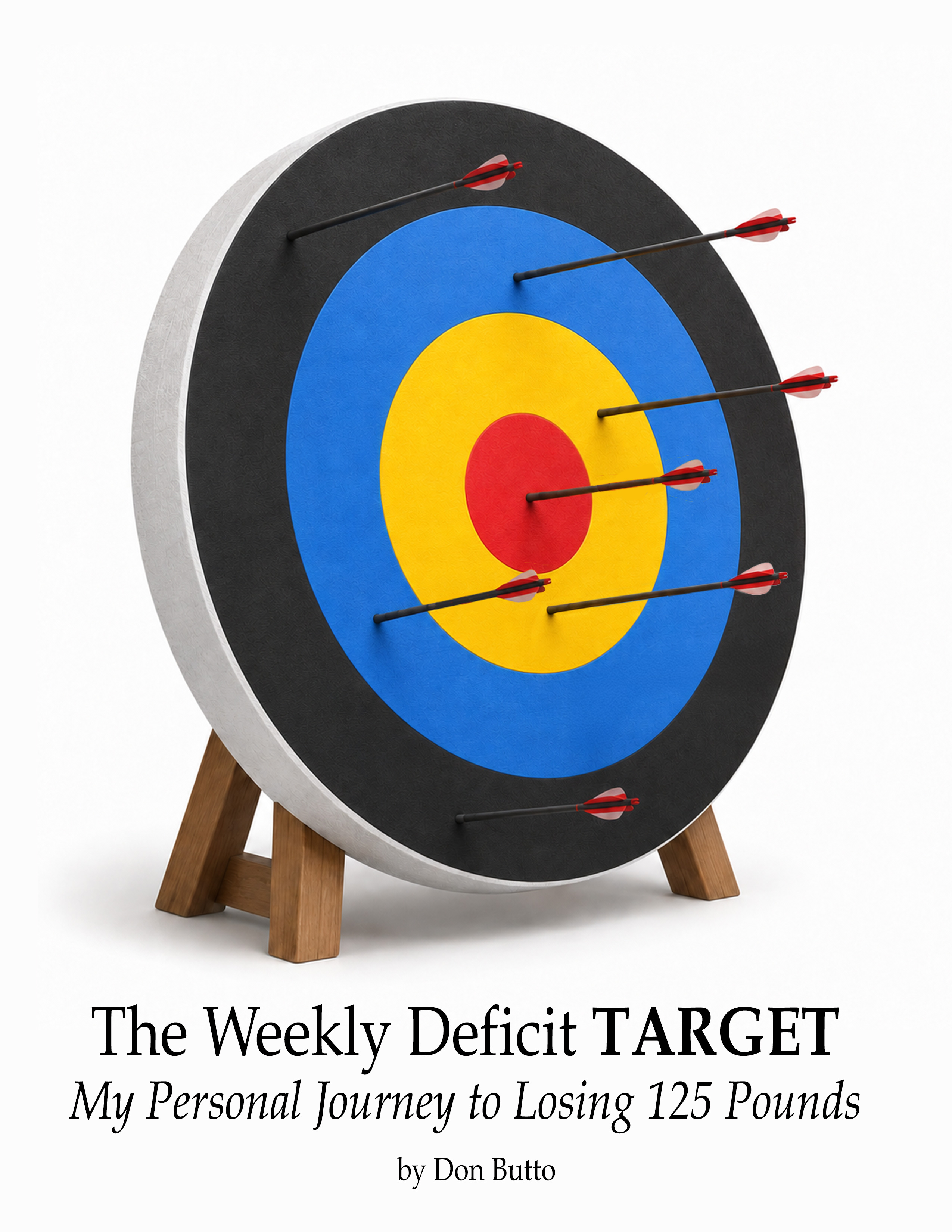
The TARGET is your weekly calorie deficit. The seven arrows represent the seven days of the week.

A bullseye is a great day with a maximum targeted deficit. An outer ring is still a good day — you made progress. What matters is hitting the board. You can even miss the target completely one day and still make progress for the week. As long as you're getting most of your arrows on the board, the math takes care of itself.
What if you miss the TARGET?
- Missed a day? No big deal. The weekly total is what matters.
- Missed a week? Acknowledge it, then get back on track.
- Missed multiple weeks? Remember your WHY and reset.
A miss can come from either side: some days you don't move as much as you planned, some days you simply eat more than your goal weight maintenance. Stuff happens — a restaurant night, a stressful week, a missed workout, a body that just wanted more food that day. None of it matters in isolation. The TARGET was never a daily number to hit perfectly; it's a weekly deficit, and a single day over rarely dents the week.
Hit the target seven times a week, anywhere on it, and the math takes care of the rest. You don't need seven bullseyes. You need seven arrows on the board.
Setting Milestones
Something I learned early: don't set one giant goal. Set small, rolling milestone goals.
I never set my goal at 190. I set small, rolling milestones — 305, then 295, then 285, then 275, and so on. Small rolling goals beat one massive number hanging over you. Hit one, feel good, set the next. Progress feels constant instead of distant.
245 vs 240: Set the milestone at 240, get under it, and then bounce back up to 242 — you failed. Set the milestone to 245 and bounce to 246 — you're still in the 240s. Same scale, completely different story in your head.
And expect plateaus. Every 10 pounds or so your body levels out for a week or ten days. Sometimes I'd deliberately eat at maintenance for a stretch, still working out, just to let things settle before pushing lower. That's not failure — that's your body adjusting. Let it. (Here's the comfort: those stalls felt very real while I lived them, but on my nine-month graph they don't even show up. The trend line erases them. Live them calmly.)
Three Rules
This whole approach comes down to three things:
Rule 1
Eat at Your Goal Weight's Maintenance Calories. This is not a temporary diet. Start eating the way you'll eat at your goal weight right now.
Rule 2
Increase activity, don't cut calories. When progress slows, keep your TARGET deficit by moving more, not eating less.
Rule 3
Understand what you're eating. Build your meals around whole foods, know your staples, and learn what's actually in your food.
This Is Not New
I'm not a dietitian or a coach, and I'm not selling anything. This is simply what worked for me.
I had tried restriction diets, brutal workouts, and yo-yo fad dieting. Same cycle every time: lose weight, plateau, quit, gain it all back plus more.
The actual system here isn't new: eat in a TARGET deficit, move more, stay consistent. What's different is the mindset shifts that make the system sustainable.
Adapt and Overcome
I didn't have this all figured out from day one. This has been a learning process the entire way. Some of what I believed early on turned out to be wrong, and I'm sure some of what I believe now will change too.
But the adjustments have worked. Every course correction came from paying attention to my own data and being honest about what it was telling me.
Don't wait until you have all the answers. You never will. Start with a solid framework, track your own data, and be willing to adjust.
Adjusting your AIM
From day one, I've been eating roughly 2,000 calories nearly every day. This is the number of calories that I will need to maintain my goal weight of 190 pounds. Yours will obviously be different and you will need to figure that out for yourself.
First Dial (weight loss): At my starting weight of 315 pounds, those 2,000 calories created a big deficit (over 1,000) and I started losing weight quickly — between 2 and 4 pounds per week — even with no exercise. Nine months later at 240 pounds, the same 2,000 calories gave me a smaller deficit (about 400). As the weight came off, I had to "move more" to maintain a steady 1 to 2 pounds of weight loss per week and hit my TARGET deficit. A slow, steady pace is exactly what I want — it's healthy, sustainable, and gives my body time to adapt.
Second Dial (maintenance): AFTER you hit your goal weight, you get to turn the second dial — and this is the part you've been working toward. You're no longer living in a deficit. Now you get to increase your calories so you're properly fueled for the work you're doing. This isn't optional — if you keep under-eating after the fat is gone, your body does not magically stop needing fuel. Severe prolonged underfeeding can cost you muscle, organ tissue, and eventually organ function. So this is both your reward and your new responsibility: eat more, fuel properly, and protect what you've built.
Rule 1 — Eat at Your Goal Weight's Maintenance Calories
Most diets fail because they have an end date. You suffer through it, hit your goal, then go back to eating "normal" — which is exactly how you got heavy in the first place. So you gain the weight back.
This approach has no end date. You start eating at your goal weight calories from day one, and that's how you keep eating. Forever.
The 36-Hour Fast
The first real mindset shift happened early on when I did a 36-hour water fast — going from Saturday dinner to Monday breakfast with nothing but water.
That experience changed something in me. It proved to me that going that long without eating really isn't a big deal. You get hungry, sure, but you're not going to die. Once I'd actually done it, it changed how I looked at calories and meal scheduling.
After that, hitting my daily calorie number became much easier. Even if I hit my calorie number by eating one big meal before noon, I could just simply stop eating. I didn't need three meals. I didn't need to snack just because it was "dinner time." I'd hit my number, and I was done for the day. Full stop.
The Foundational Change
When I started this journey, I was obsessed with my fitness watch. I'd try to run a 1,000-calorie deficit every single day, no matter what. On low activity days, I'd severely restrict my food. On big activity days, I'd tell myself I'd "earned it" and eat a lot more. I was either starving or stuffing myself. There was no middle ground. I was still "dieting."
This time I threw all that out. Now I eat roughly 2,000 calories just about every day. The number doesn't really change. What changes is my activity. I stopped living and dying by my watch. For the first time, I'm not "on a diet."
I simply decided how I would eat at 190 pounds, and I started eating that way immediately. I did the math for where I'm going, not where I am. At 190 pounds, 6 feet tall, I'll burn roughly 2,000 calories a day just existing. So that's what I eat now — and that's what I'll eat for the rest of my life.
The Shrinking Deficit
The heavier you are, the more calories your body burns just to exist and move around. So the same number of calories that will maintain your weight at your goal weight creates a real deficit right now. And early on, that deficit could be quite large.
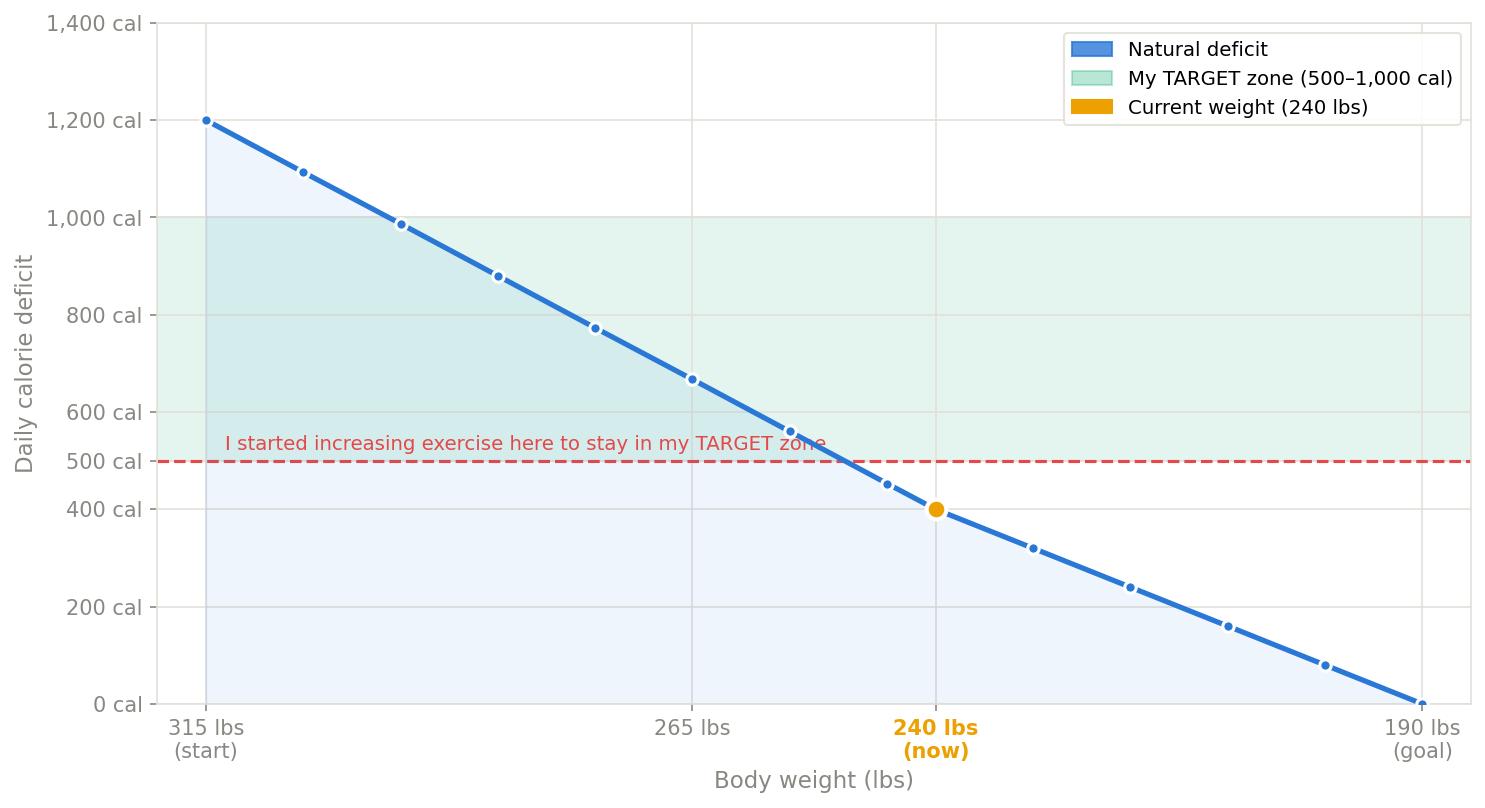
That drop in your natural deficit is by design, not a flaw. As you lose weight, the "free" deficit you got simply from being heavier starts to disappear. That's normal. The answer is never to cut your calories further. That's exactly how crash diets fail. Instead, this is where Rule 2 comes in — when your food math slows down, you increase activity to bring the TARGET deficit back up.
To find your number: plug your goal weight, age, height, and normal daily activity into any maintenance calculator. Mine landed at 2,000. It's an estimate, not gospel — eat that number, track honestly for a few weeks, watch the scale, and adjust. Your own data beats the calculator every time.
Yes, my number happens to be the same 2,000 you see on every nutrition label — pure coincidence of my height, age, and goal weight. Don't read anything into it. That label number is a generic population average for maintaining your current weight; mine is a calculated target for my goal weight. Same digits, completely different math. Run your own — yours will almost certainly land somewhere else.
Data, Not Emotions: Record your weight every morning at the same time. I do that after coffee and/or first trip to the bathroom and before breakfast, then forget about it. Don't worry about whether it went up or down. Spend energy counting and understanding grams (food), not ounces (body weight). At the end of the week, average the last 7 days and compare it to the previous week's average to see meaningful gain/loss data.
Work on the Food First
For the last five years or more, I tried to lose weight by exercising alone. I did a lot of walking and hiking. I even went through a phase where I was doing nearly a thousand push-ups a day. I'd get my weight down 50 or so pounds, but I always ended up gaining it back.
The problem was simple: I never fixed how I ate. I wasn't drinking sodas, sweet tea or eating a bunch of candy, but I was eating out a lot and I completely refused to track anything. I didn't want to deal with it. So every time I got serious about exercise, I'd lose weight, but as soon as my motivation dropped, the weight came right back.
This time I did the opposite. I locked in my eating at my goal weight maintenance calories before I added any real exercise. At about 30 pounds down I started walking and hiking short distances again. At about 55 pounds down I started doing bigger walks and going to the gym. That's what finally let me break through the wall that had always stopped me before.
The order matters. Yes, you can lose weight with exercise alone, and you can keep it off as long as you keep exercising. But most people don't. Eventually life gets busy, motivation drops, and the exercise stops. Since your diet is what got you overweight in the first place, that's what you have to fix if you want lasting control.
The Bottom Line
Decide on your goal weight and then calculate how many calories you'll need to maintain that weight. Start eating that way right now. Track your food and your weight, and let the math do the work. The same approach that takes the weight off is the one that keeps it off. The number that gets you there is the number that keeps you there.
It's important to remember that the free deficit you get simply from being heavier will shrink as you lose weight. When that happens, the answer is never to eat less. The real answer is to move more — and that's Rule 2.
Rule 2 — Increase Activity, Don't Cut Calories
I used to do the same thing over and over: get motivated, go way too hard, push myself into workouts I had no business doing, burn out, quit, and gain all the weight back. I did this at least five times.
This time I did the opposite. Instead of trying to lose weight by eating less, I focused on moving more. And I've learned that creating a deficit through activity is far more sustainable than trying to create it through restriction.
The Pattern I Broke
It's a familiar trap: I'd decide to lose weight, cut calories, and start exercising hard all at the same time. It would work for a while, but eventually I'd push too hard, bite off way more than I could handle, and crash. It's called over-reaching — taking on something I had no business doing yet.
Over-reaching can bite anyone, but it is especially tough after 50. The recovery takes longer, and the hit to your motivation is even bigger than the physical toll. I learned that the hard way on a hike in the Smokies. A bad enough crash didn't have to injure me physically — it just had to discourage me enough that I stopped showing up. That's how I ended up gaining the weight back multiple times.
This time I did it differently. I locked in my eating first — 2,000 calories a day with zero exercise — and I didn't add serious training until I was already past my 265-pound wall. By then the diet was already working, so "moving more" became an addition to the deficit instead of the only thing creating it.
Why Restriction Fails
You can only cut calories so far before you hit a hard floor. If you keep forcing a big daily deficit as you lose weight, you'll eventually be eating fewer calories than your goal weight needs just to maintain. That means you're on a temporary diet — and when you reach your goal, you're naturally going to go back to eating more. That's exactly how the yo-yo begins.
Activity doesn't have that same limitation. You can always walk a little farther, add another session, or move more throughout your day — as long as you don't over-reach. You have a lot more room to increase movement than you do to keep cutting calories.
The Four Phases
Most "before and after" stories leave out a critical truth: the natural deficit doesn't stay the same as you lose weight. As you get lighter, your body naturally requires fewer calories, so eating at your goal weight maintenance calories creates a smaller and smaller deficit as you progress. That means the amount of active calories burned has to scale up as you go — not that your calories have to scale down. There are four distinct phases in this process. Here's what mine looked like:
Phase 1 — In the Beginning
At 315 pounds I was burning roughly 3,200 calories a day just existing. Eating at my goal weight maintenance calories of 2,000 created an aggressive 1,200-calorie deficit without doing any exercise at all. The weight fell off fast and easy. This is the phase that fools people into thinking they've got it licked. Enjoy it, but know it's a starting gift, not the norm. If your goal weight is less than 70 or 80 pounds below your current weight, you will not experience this aggressive deficit and will likely skip Phase 1 entirely.
Phase 2 — Light Exercise
By this point, my maintenance calories were no longer creating the deficit they did before. The aggressive 1,200-calorie deficit I had in the beginning had slowly dropped to roughly 600–700 calories. Instead of cutting calories, I added movement. I started going on short walks after meals to reach 6,500 to 10,000 steps per day. That was enough to bring my deficit back into the TARGET range I wanted. The eating never changed — the activity did.
Phase 3 — The Real Work
My maintenance calories were only creating about a 400-calorie deficit on their own — which is below the 500 to 1,000 calorie range I was trying to maintain. This is where the real work started: longer walks and lifting weights 3 to 4 times a week. I was now exercising both to manufacture the deficit my body no longer gave me for free, and to improve my body composition.
Phase 4 — At Goal Weight
This is where the system flips. At goal weight, eating my maintenance calories with no exercise will keep my weight stable. But if I'm still hitting the gym and hiking regularly, I will need more than maintenance calories as extra fuel for those activities. The same activity that created a deficit now creates a food requirement. I'm eating more than I did while losing weight, but I'm maintaining because the math now matches my actual burn. That's not just reaching a number on the scale. That's reaching a place where your effort gets rewarded with abundance instead of restriction.
My Weight Loss Progress
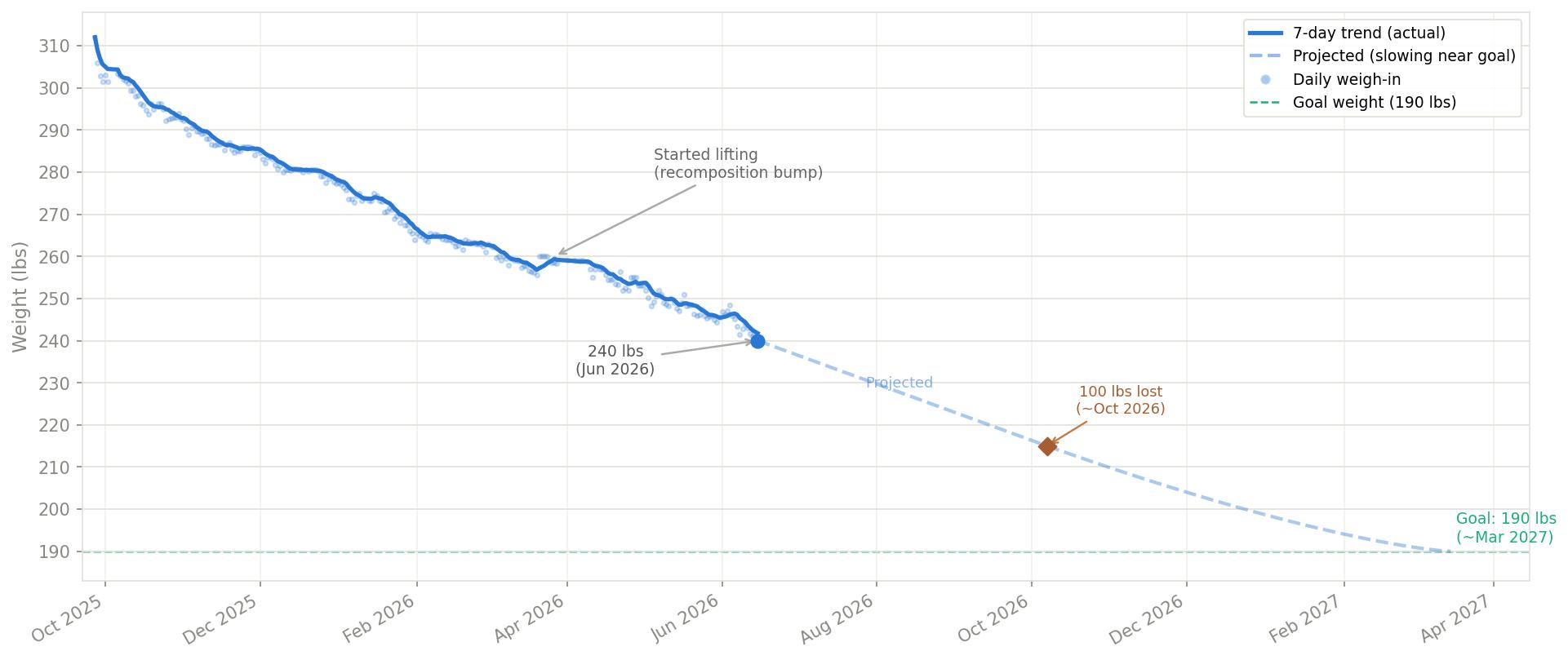
The day-to-day scale bounces like anyone's, but they don't matter. There's only been one real wiggle on the entire chart. That small bump in March wasn't a stall — that was the month I started lifting weights and my body began recomposition. If I hadn't expected it, I might have panicked. The real lesson is this: trust the trend, not the daily noise.
Weight Loss Pacing
Weight loss pacing can be both natural and intentional. You don't need to aim for 2 pounds a week the whole way down. You can still lose weight without exercise, but the pace will naturally slow as you get closer to your goal.
Here's a realization I had very early: once you understand the math, the temptation to lose weight fast is hard to resist. If a 500-calorie daily deficit target equals one pound per week and 1,000 calories equals two, why not push for a 2,000-calorie deficit and get there four times faster?
Don't.
Even if your diet stays healthy and the extra deficit comes from activity instead of starvation, there are good reasons to cap it around 2–3 pounds a week — and slower as you get close:
- You risk losing muscle. Your body doesn't care whether it burns fat or muscle for energy. If you're consistently running a large deficit without also consistently hitting your protein needs, you're going to lose significant muscle.
- Your skin needs time to respond. Lose the weight too quickly and your skin doesn't have time to adapt. Skin elasticity decreases with age, so the faster you lose, the higher the chance you'll end up with loose, sagging skin.
- The habits might not stick. I deliberately wanted a full year of eating this way — through holidays, vacations, and stressful weeks — so that by the time I reached goal weight, the pattern felt completely natural. If you race to your goal too fast, you simply haven't had enough time for those new habits to feel normal.
Fast is possible. Fast is even tempting. But the goal was never to get there fast — it's to get there once.
The Bottom Line
A Weekly Deficit TARGET through activity is sustainable. Deficit through restriction isn't.
Rule 2 comes down to one idea: the food stays the same. When your natural deficit shrinks, you don't eat less — you move more. The same "goal weight" calories that created big results early on will eventually need to be supplemented with increased daily activity.
Rule 3 — Understand What You're Eating
People ask me almost every day: "What are you doing to lose weight?" or "What did you cut out of your diet?" They expect a laundry list, like: no bread, no sugar, no carbs, etc. The answer to the question is, I haven't really cut out anything. I still eat pizza and ice cream. I still drink beer. I haven't "banned" a single food and that's actually really important. The moment this starts feeling like permanent deprivation, it's not going to work.
Here's what has changed: I do eat pretty clean most of the time. I eat real food at home using the highest quality ingredients I can get 90% of the time. I work hard to understand exactly what I'm eating, and I've built all of it around staying satisfied on my personal goal weight maintenance calories.
Healthy food every day. Comfort food once a week. Junk food once a month.
Food Is Fuel
Food is fuel. Your body burns it for energy, period. It doesn't actually care whether the fuel is a doughnut or a chicken breast — it runs the same physics on both.
There's a real-world example that proves it — not a story, an actual experiment. In 2010, Mark Haub, a nutrition professor at Kansas State University, put himself on a diet of mostly junk food for 10 weeks: Twinkies, Oreos, Doritos, sugary cereals. Two-thirds of his calories came from the kind of stuff every diet on earth tells you to avoid completely. The catch? He capped himself at under 1,800 calories a day.
The results: 27 pounds gone in 10 weeks — 201 down to 174. Body fat from 33.4% to 24.9%. And here's the kicker — all of his health markers improved. Bad cholesterol down 20%, good cholesterol up 20%, triglycerides down 39%, blood pressure down.
Haub himself wouldn't call his diet healthy. No fruits, no vegetables, no fiber, no whole foods — nobody knows what running like that long-term does to you. He wasn't recommending the diet. Neither am I. He was proving a point about calories.
Here's the part people get backwards, though: they won't start because they can't do it "perfectly." But the food quality was never the thing out to get them. The extra 100 pounds is. Carrying an extra 100 pounds is stress on your heart, joints, blood pressure, liver, kidneys, and metabolism — and over time, yes, it can kill you. Getting that weight off is one of the biggest health moves you can make.
A healthier diet is better — obviously, and you refine it as you go. But "I can't eat perfectly" is no reason to keep carrying the weight that's actually doing the damage. Get it off first. Clean it up along the way.
You Have to Count. I'm Sorry, But You Do.
For most of my life I flat-out refused to count calories. So here's what "not counting" actually looked like: I had no idea what I was eating. None. I ate whatever looked good, in whatever amount showed up, and I'd have sworn I was eating "pretty normal." I was eating 3,200-plus a day and couldn't have told you within a thousand calories.
So I'll say the thing nobody wants to hear: you have to know what the heck you're putting in your mouth, or absolutely none of this matters. The mindset, the exercise, none of it. Without real numbers it's all guesswork — and a guess can land on either side by a mile.
That means weighing things — in grams, with a cheap kitchen scale — and calculating the calories of everything you eat. The good news is it's a front-loaded cost, not a life sentence: a few weeks of honest weighing is all it takes.
What finally broke my refusal, after decades? Honestly — AI. I snap a photo of a label or a plate of food, or just say what I ate, and I get the numbers instantly with a running total for the day. No food databases to dig through, no spreadsheet homework. The friction dropped to nearly zero, and the moment tracking got that easy, my excuse died.
To be clear: the AI isn't the requirement — a tracking app or a notebook and a scale do the same job. The counting is the requirement.
Why Most Diets Fail
Once you see that counting is the real requirement, you can see what every popular diet actually is: keto, vegan, low-carb, low-fat, paleo, whatever's trending this year — they're all just indirect ways of reducing calories. Cut out an entire food group and yes, you'll probably eat less. So they work — at first.
Then they stop, and here's why. Your maintenance burn shrinks as you lose weight. The diet doesn't adapt — it's the same food list at 280 pounds as at 240. So somewhere along the way, the indirect calorie cut quietly stops being a deficit at all. And because the person was never tracking — the diet promised they wouldn't have to — they have no idea why it stopped working. They conclude the diet failed, or their metabolism is broken, and they quit. Sound familiar?
That's the whole sales pitch of named diets: "follow the rules and you'll never have to count." And it's exactly why they fail. The rules can't see your numbers. You can.
Knowing Your Staples
Here's the thing that makes counting genuinely easy: you're already a creature of habit. Most people eat the same 10–15 meals on repeat — chicken night, taco night, the usual breakfast, the regular lunch spot. You don't need to learn every food on earth. You only need to learn the calories and portions of the foods you actually eat.
When I started, I had no feel for portions. So I tracked everything for a few weeks: every chicken breast, every bowl of rice, every snack. Patterns emerged fast. Chicken breast: ~165 cal, 31g protein. A cup of cooked rice: ~200 cal. An egg: ~80 cal, 6g protein. My usual breakfast: ~400 cal, 20g protein.
Once you know your staples, logging stops being work — it's just recall. After you get this down, it's just math and patience.
And portions are where the setup pays off most. My "cup of rice" was closer to 1.5. My "serving" of peanut butter was triple the real thing. I'd been underestimating by 200–300 calories a meal without knowing it. A few weeks of weighing calibrated my eyes for good — now I can look at a chicken breast and know it's about 165 calories. You don't have to weigh forever, just long enough to train your eyes.
Protein: Burn Fat, Not Muscle
Calories are the main lever for weight loss. Protein does a different job: muscle preservation. You want to lose fat, not muscle, and protein is what protects it.
Here is the framework I've landed on for myself: from 0.7g per pound of my current weight to 1.0g per pound of my goal weight. At 240 pounds and a goal weight of 190 pounds, I try to get between 168 and 190g of protein per day. Some days I hit it and some days I don't, but having a goal and getting close is better than shooting in the dark.
Carbs: Eat for What's Next, Not What You Just Did
Most people eat based on the past: "I burned 500 calories today, so I've earned 500 extra." That's backward — you're rewarding something that already happened instead of fueling what's coming.
Flip it: "Hiking in two hours — carbs now." "Just lifted — protein today." "Bed in four hours — eat light or skip it." Carbs before activity, protein after — carbs fuel the work ahead; protein repairs what the work just did. Basic biology, nothing secret. That rhythm naturally regulates intake without you thinking about it.
Weekly Average, Not Daily Perfection
One low-calorie deficit day is a single arrow in the outer ring — noise. It's the seven-day total weekly deficit that decides whether the week worked, and the monthly average that decides whether the system does.
A few half-hearted weeks might net 2–2.5 pounds of weight loss for the month. Consistent weeks — moving regularly, hitting calories, being intentional — generally net closer to double that at 7–8 pounds.
Restaurant Sodium: Almost all restaurant food is heavily over-dosed with sodium. I went out to eat one night and the next morning I was up three pounds on the scale. My body was simply holding extra water to dilute all that sodium — exactly what it's supposed to do. It had nothing to do with fat gain. The water weight appeared fast and disappeared just as fast, usually within a day or two. Weigh every day to build the habit and avoid surprises, but judge yourself only on the weekly average.
The Bottom Line
Consistency is king. Intentionality is critical. Know your own body, your own numbers, your own staples — don't follow someone else's plan or chase "clean eating" as an identity. Named diets fail because they can't see your numbers.
Track. Weigh the food. Learn your staples cold, estimate the rest as best you can. Protect the protein. Time the treats. Then show up — week after week, month after month — and let the average do its thing.
My Approach — How I Actually Do It
The three rules are the system. This section is what the system looks like running inside one actual life — mine. None of it is required. All of it is honest. Use what fits, skip what doesn't.
What My Wife Tells People
When people hear about the miles I'm walking and hiking, they tell my wife: "I can't do what Don's doing — he walks 10 to 20 miles a day. I can't walk 2 miles." So they don't even start.
Rita's answer shocks most: "The walking and the gym is not how he's losing weight. He's losing weight by monitoring what he's eating. He hasn't cut out delicious food — we have buttermilk pancakes, pizza, Klondike bars regularly — but he absolutely monitors how much. In fact, the hiking and the gym are building muscle, which makes him GAIN weight, not lose it."
She's right on every count. The big miles are my hobby and my durability project — I'm training for a thru-hike of the Appalachian Trail, not for weight loss. The scale moves because of what happens in the kitchen. The muscle I'm building actually works against the scale.
So if you can't walk 20 miles, good news: neither could I when I weighed 315, and it didn't matter. Your goal might be two miles. It might be 20 minutes. Activity scales to you — it's the tuning knob, not the engine. The important part is knowing what you're putting in your mouth.
Identifying My Calorie Bombs
I told you in Rule 3 that I haven't cut out a single food. That's true at the level of categories — nothing's banned forever. But I'd be lying if I said I didn't pull a few specific things almost all the way out, on purpose, for now at least.
Everyone has trip-wires — the handful of things they love that quietly wreck the budget and tend to trigger more bad days. I know mine are beer and fried foods. I've cut all of them 99-plus percent — not by white-knuckling, but because I looked at each one honestly and admitted it works directly against what I'm after right now. So, now, I drink non-alcoholic low-cal beers and I'll still steal a fry off Rita's plate vs. ordering my own. Sorry, Rita.
Your trip-wires won't be mine. For a lot of people in North Carolina it's sweet tea — basically liquid sugar. At 200+ calories per 20 oz. cup, it adds up really fast. The framework isn't "give up your favorite thing." It's: find the few things actually blocking you, be honest about whether you can have them in moderation or not, and decide what they're worth right now.
And sometimes the answer isn't cutting — it's swapping. Beer was a bottleneck for me, so I went from 250-calorie Belgian Pale Strong Ale to 25 to 60-calorie NA beer. Still beer, still enjoying it, just sized to fit. If sweet tea's your thing, here's an easy swap: go with unsweetened tea and a few drops of lemon-flavored liquid stevia. Sweet tea taste, zero calories. That's not abstinence, and it's not deprivation. It's knowing your own numbers and your own weak spots well enough to make the trade-off on purpose.
A Reset Day
Usually once a week, on a Sunday, I'll take a day that's deliberately different: a rest-and-recovery day where I eat half of my maintenance calories, or sometimes don't eat at all.
Caution: If you have any underlying medical issues, consult with your medical doctor before you attempt a fast of any kind.
I'm not going to hand you a science lecture about fasting — there's plenty of that online and a lot of it is just hype. I can only tell you what it does for me: it reminds my brain that a little hunger isn't going to kill me.
These days my reset day is usually softer than water-only: the 50% day. Eat if your body asks — just keep it to something super easy to digest and super hydrating. For me that's watermelon. Watermelon is my favorite food on the planet, so "eat watermelon all day" isn't punishment — it's a treat. Pick whatever works the same way for you.
Why I keep it in the rotation:
- It forces an off-day. You're not fueled for a workout, so you shouldn't talk yourself into one.
- It keeps the mental edge. One day a week of proving that not eating won't actually kill you.
- It's a weekly deficit safety net. Week got away from you? One reset day quietly catches the week back up.
- It sets the weekly tone. Starting Monday at your lowest weight of the week gives you a real psychological win.
Skin Health and Why It Matters
Sodium, potassium, magnesium, fat — your body needs all of it to keep running. If your macros are dialed in and you're eating mostly whole foods, the micronutrients come along for the ride.
The only supplements I take regularly: collagen in my morning coffee, backed up with vitamin C, and omega-3 with dinner. The omega-3 is joint support and the collagen and vitamin C are part of something I think about constantly — my skin.
Here's the honest truth nobody pushing a lose-weight-fast program likes to talk about: lose 100-plus pounds fast and you risk loose, hanging skin at the end of it. For me that's been a real, ongoing concern, and I've purposefully been losing the weight at a measured pace, taking collagen and vitamin C daily, no smoking, no sun tanning, sunscreen every day. None of it's a magic fix, but together I'm hoping that it gives my skin its best shot at keeping up.
Skin elasticity only goes one direction with age — it gets harder to bounce back every year you wait. The best time to take it off was a year ago; the second-best time is right now.
That's It
I'm not a dietitian or a coach, and I'm not selling you anything. This is what worked for me — simple enough to share because it isn't unique enough to keep to myself.
Weight loss isn't complicated. It isn't magic. It's calories in, calories out, and showing up.
The Reality
You didn't gain the weight in a month. Don't expect to lose it in one. Weight loss is hard — not because it's complicated, but because consistency is hard. Showing up every day, riding out the weeks that don't go your way, trusting that progress isn't a straight line — that's the actual work. I tell people all the time... this is just math and patience now.
But it's doable. It's sustainable. And a year from now you could be a different person — lighter, stronger, moving through your life instead of being limited by it.
Somewhere along the way I read four words that stopped me cold: simple doesn't mean easy.
That's this past year. None of it has been "easy" — not the first week, not the wall at 265, not the nights I wanted to eat the whole kitchen. I get emotional about that, because it has NOT been easy.
Simple is what makes it doable. Not being easy is what makes it worth something.
Why This Works — The Science (Optional)
This page is optional. If you just want the rules and you trust that they work, skip this and go use them. But if you're the type who needs to understand why something works before you'll actually commit to it, this one's for you.
Why the Deficit Shrinks: It's Not Just "Less Body to Feed"
Some of the shrinking deficit is simple and obvious — a smaller body needs fewer calories to maintain itself, the same way a smaller house costs less to heat. That part's just math.
But there's a second piece that surprised me when I learned about it: your body can also dial its own engine down. As fat stores shrink, a hormone called leptin drops, and falling leptin tells your brain to quietly throttle a few things — how much you fidget and move without thinking about it (called NEAT — non-exercise activity thermogenesis), how efficiently your thyroid converts into its active form, even how hard your nervous system is firing. None of that shows up as a decision you make. It just happens, in the background, as a survival response to sustained deficit.
I'm not a scientist, and I don't need to fully understand the biochemistry to work around it. I just need to know it's happening so I don't panic when the scale slows down and assume I'm doing something wrong. I'm not — my body is just doing exactly what bodies do under sustained deficit.
On the flip-side, muscle tissue burns more at rest than fat tissue does, pound for pound. Not a massive amount per pound, but it adds up. So if the gym work is actually building or holding onto muscle and I'm losing fat — my body is heating up metabolically and burning more calories just existing.
That's the tug-of-war happening underneath the surface the whole time. My body is trying to throttle down (the leptin/NEAT side), and my training is actively fighting back (the muscle side). So far, deep into this, they've roughly balanced out — which is exactly why my weekly loss rate hasn't visibly decayed the way the textbook expects it to by this point. That's not luck, that's the "eat less, move more" working exactly as designed.
Want More?
Recipes, fitness logs, hike reports, and all the messy details at donbutto.com/target/
Questions or feedback? donbutto.com/contact