

The Weekly Deficit TARGET
Rule 1
Eat at Your Goal Weight's Maintenance Calories
Most diets fail because they have an end date. You suffer through it, hit your goal, then go back to eating "normal" — which is exactly how you got heavy in the first place. So you gain the weight back.
This approach has no end date. You start eating at your goal weight calories from day one, and that's how you keep eating. Forever.
The 36-Hour Fast
The first real mindset shift happened early on when I did a 36-hour water fast — going from Saturday dinner to Monday breakfast with nothing but water.
That experience changed something in me. It proved to me that going that long without eating really isn't a big deal. You get hungry, sure, but you're not going to die. Once I'd actually done it, it changed how I looked at calories and meal scheduling.
After that, hitting my daily calorie number became much easier. Even if I hit my calorie number by eating one big meal before noon, I could just simply stop eating. I didn't need three meals. I didn't need to snack just because it was "dinner time." I'd hit my number, and I was done for the day. Full stop.
The Foundational Change
When I started this journey, I was obsessed with my fitness watch. I'd try to run a 1,000-calorie deficit every single day, no matter what. On low activity days, I'd severely restrict my food. On big activity days, I'd tell myself I'd "earned it" and eat a lot more. I was either starving or stuffing myself. There was no middle ground. I was still "dieting."
This time I threw all that out. Now I eat roughly 2,000 calories just about every day. The number doesn't really change. What changes is my activity. I stopped living and dying by my watch. For the first time, I'm not "on a diet."
I simply decided how I would eat at 190 pounds, and I started eating that way immediately. I did the math for where I'm going, not where I am. At 190 pounds, 6 feet tall, I'll burn roughly 2,000 calories a day just existing. So that's what I eat now — and that's what I'll eat for the rest of my life.
The Shrinking Deficit
The heavier you are, the more calories your body burns just to exist and move around. So the same number of calories that will maintain your weight at your goal weight creates a real deficit right now. And early on, that deficit could be quite large.
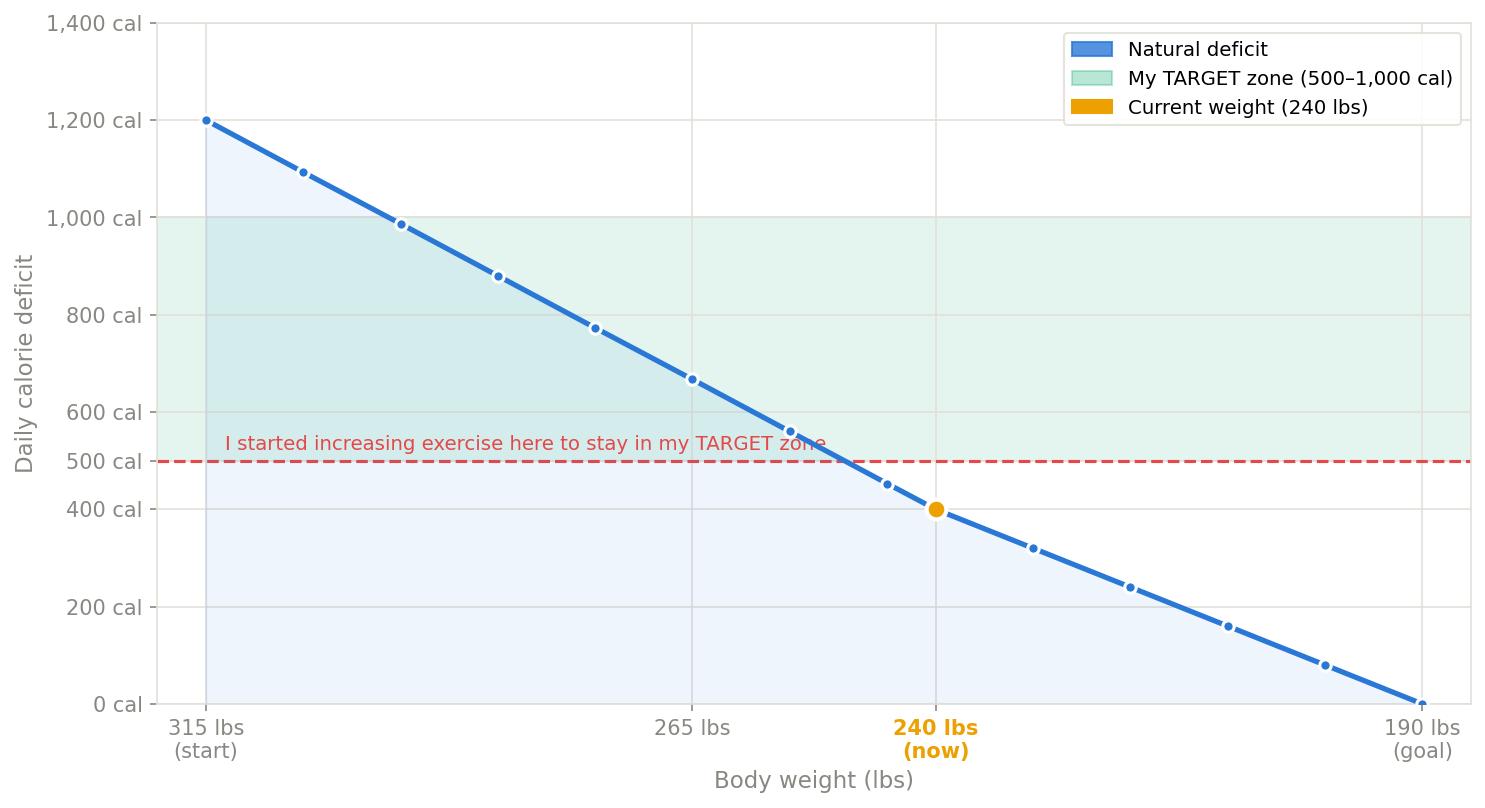
That drop in your natural deficit is by design, not a flaw. As you lose weight, the "free" deficit you got simply from being heavier starts to disappear. That's normal. The answer is never to cut your calories further. That's exactly how crash diets fail. Instead, this is where Rule 2 comes in — when your food math slows down, you increase activity to bring the TARGET deficit back up.
To find your number: plug your goal weight, age, height, and normal daily activity into any maintenance calculator. Mine landed at 2,000. It's an estimate, not gospel — eat that number, track honestly for a few weeks, watch the scale, and adjust. Your own data beats the calculator every time.
Yes, my number happens to be the same 2,000 you see on every nutrition label — pure coincidence of my height, age, and goal weight. Don't read anything into it. That label number is a generic population average for maintaining your current weight; mine is a calculated target for my goal weight. Same digits, completely different math. Run your own — yours will almost certainly land somewhere else.
Data, Not Emotions: Record your weight every morning at the same time. I do that after coffee and/or first trip to the bathroom and before breakfast, then forget about it. Don't worry about whether it went up or down. Spend energy counting and understanding grams (food), not ounces (body weight). At the end of the week, average the last 7 days and compare it to the previous week's average to see meaningful gain/loss data.
Work on the Food First
For the last five years or more, I tried to lose weight by exercising alone. I did a lot of walking and hiking. I even went through a phase where I was doing nearly a thousand push-ups a day. I'd get my weight down 50 or so pounds, but I always ended up gaining it back.
The problem was simple: I never fixed how I ate. I wasn't drinking sodas, sweet tea or eating a bunch of candy, but I was eating out a lot and I completely refused to track anything. I didn't want to deal with it. So every time I got serious about exercise, I'd lose weight, but as soon as my motivation dropped, the weight came right back.
This time I did the opposite. I locked in my eating at my goal weight maintenance calories before I added any real exercise. At about 30 pounds down I started walking and hiking short distances again. At about 55 pounds down I started doing bigger walks and going to the gym. That's what finally let me break through the wall that had always stopped me before.
The order matters. Yes, you can lose weight with exercise alone, and you can keep it off as long as you keep exercising. But most people don't. Eventually life gets busy, motivation drops, and the exercise stops. Since your diet is what got you overweight in the first place, that's what you have to fix if you want lasting control.
The Bottom Line
Decide on your goal weight and then calculate how many calories you'll need to maintain that weight. Start eating that way right now. Track your food and your weight, and let the math do the work. The same approach that takes the weight off is the one that keeps it off. The number that gets you there is the number that keeps you there.
It's important to remember that the free deficit you get simply from being heavier will shrink as you lose weight. When that happens, the answer is never to eat less. The real answer is to move more — and that's Rule 2.