

The Weekly Deficit TARGET
Rule 2
Increase Activity, Don't Cut Calories
I used to do the same thing over and over: get motivated, go way too hard, push myself into workouts I had no business doing, burn out, quit, and gain all the weight back. I did this at least five times.
This time I did the opposite. Instead of trying to lose weight by eating less, I focused on moving more. And I've learned that creating a deficit through activity is far more sustainable than trying to create it through restriction.
The Pattern I Broke
It's a familiar trap: I'd decide to lose weight, cut calories, and start exercising hard all at the same time. It would work for a while, but eventually I'd push too hard, bite off way more than I could handle, and crash. It's called over-reaching — taking on something I had no business doing yet.
Over-reaching can bite anyone, but it is especially tough after 50. The recovery takes longer, and the hit to your motivation is even bigger than the physical toll. I learned that the hard way on a hike in the Smokies. A bad enough crash didn't have to injure me physically — it just had to discourage me enough that I stopped showing up. That's how I ended up gaining the weight back multiple times.
This time I did it differently. I locked in my eating first — 2,000 calories a day with zero exercise — and I didn't add serious training until I was already past my 265-pound wall. By then the diet was already working, so "moving more" became an addition to the deficit instead of the only thing creating it.
Why Restriction Fails
You can only cut calories so far before you hit a hard floor. If you keep forcing a big daily deficit as you lose weight, you'll eventually be eating fewer calories than your goal weight needs just to maintain. That means you're on a temporary diet — and when you reach your goal, you're naturally going to go back to eating more. That's exactly how the yo-yo begins.
Activity doesn't have that same limitation. You can always walk a little farther, add another session, or move more throughout your day — as long as you don't over-reach. You have a lot more room to increase movement than you do to keep cutting calories.
The Four Phases
Most "before and after" stories leave out a critical truth: the natural deficit doesn't stay the same as you lose weight. As you get lighter, your body naturally requires fewer calories, so eating at your goal weight maintenance calories creates a smaller and smaller deficit as you progress. That means the amount of active calories burned has to scale up as you go — not that your calories have to scale down. There are four distinct phases in this process. Here's what mine looked like:
Phase 1 — In the Beginning
At 315 pounds I was burning roughly 3,200 calories a day just existing. Eating at my goal weight maintenance calories of 2,000 created an aggressive 1,200-calorie deficit without doing any exercise at all. The weight fell off fast and easy. This is the phase that fools people into thinking they've got it licked. Enjoy it, but know it's a starting gift, not the norm. If your goal weight is less than 70 or 80 pounds below your current weight, you will not experience this aggressive deficit and will likely skip Phase 1 entirely.
Phase 2 — Light Exercise
By this point, my maintenance calories were no longer creating the deficit they did before. The aggressive 1,200-calorie deficit I had in the beginning had slowly dropped to roughly 600–700 calories. Instead of cutting calories, I added movement. I started going on short walks after meals to reach 6,500 to 10,000 steps per day. That was enough to bring my deficit back into the TARGET range I wanted. The eating never changed — the activity did.
Phase 3 — The Real Work
My maintenance calories were only creating about a 400-calorie deficit on their own — which is below the 500 to 1,000 calorie range I was trying to maintain. This is where the real work started: longer walks and lifting weights 3 to 4 times a week. I was now exercising both to manufacture the deficit my body no longer gave me for free, and to improve my body composition.
Phase 4 — At Goal Weight
This is where the system flips. At goal weight, eating my maintenance calories with no exercise will keep my weight stable. But if I'm still hitting the gym and hiking regularly, I will need more than maintenance calories as extra fuel for those activities. The same activity that created a deficit now creates a food requirement. I'm eating more than I did while losing weight, but I'm maintaining because the math now matches my actual burn. That's not just reaching a number on the scale. That's reaching a place where your effort gets rewarded with abundance instead of restriction.
My Weight Loss Progress
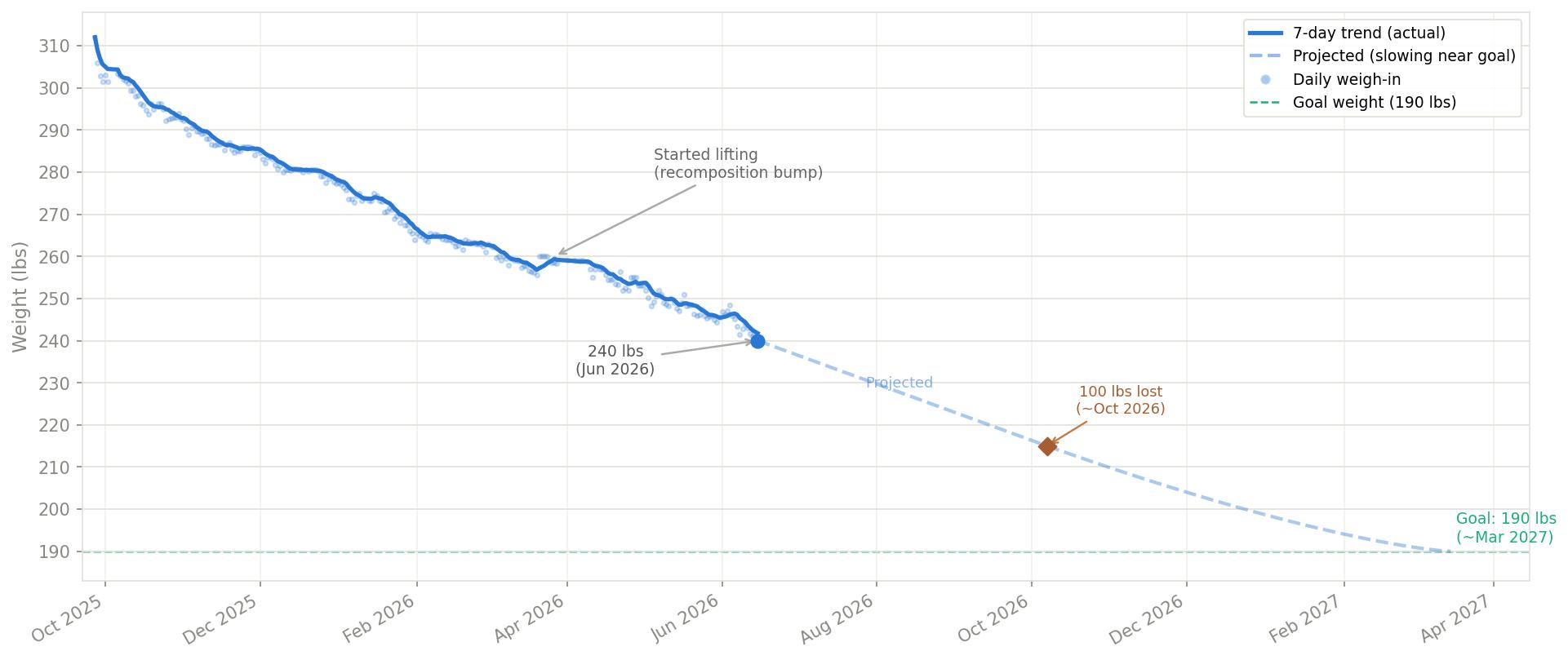
The day-to-day scale bounces like anyone's, but they don't matter. There's only been one real wiggle on the entire chart. That small bump in March wasn't a stall — that was the month I started lifting weights and my body began recomposition. If I hadn't expected it, I might have panicked. The real lesson is this: trust the trend, not the daily noise.
Weight Loss Pacing
Weight loss pacing can be both natural and intentional. You don't need to aim for 2 pounds a week the whole way down. You can still lose weight without exercise, but the pace will naturally slow as you get closer to your goal.
Here's a realization I had very early: once you understand the math, the temptation to lose weight fast is hard to resist. If a 500-calorie daily deficit target equals one pound per week and 1,000 calories equals two, why not push for a 2,000-calorie deficit and get there four times faster?
Don't.
Even if your diet stays healthy and the extra deficit comes from activity instead of starvation, there are good reasons to cap it around 2–3 pounds a week — and slower as you get close:
- You risk losing muscle. Your body doesn't care whether it burns fat or muscle for energy. If you're consistently running a large deficit without also consistently hitting your protein needs, you're going to lose significant muscle.
- Your skin needs time to respond. Lose the weight too quickly and your skin doesn't have time to adapt. Skin elasticity decreases with age, so the faster you lose, the higher the chance you'll end up with loose, sagging skin.
- The habits might not stick. I deliberately wanted a full year of eating this way — through holidays, vacations, and stressful weeks — so that by the time I reached goal weight, the pattern felt completely natural. If you race to your goal too fast, you simply haven't had enough time for those new habits to feel normal.
Fast is possible. Fast is even tempting. But the goal was never to get there fast — it's to get there once.
The Bottom Line
A Weekly Deficit TARGET through activity is sustainable. Deficit through restriction isn't.
Rule 2 comes down to one idea: the food stays the same. When your natural deficit shrinks, you don't eat less — you move more. The same "goal weight" calories that created big results early on will eventually need to be supplemented with increased daily activity.